
America's Most Dangerous Roads: A Data-Driven Analysis
Analysis of 1.3M DOT crash records reveals America's most dangerous roads when normalized by traffic volume. I-80 in Wyoming tops the list with 277 fatalities.
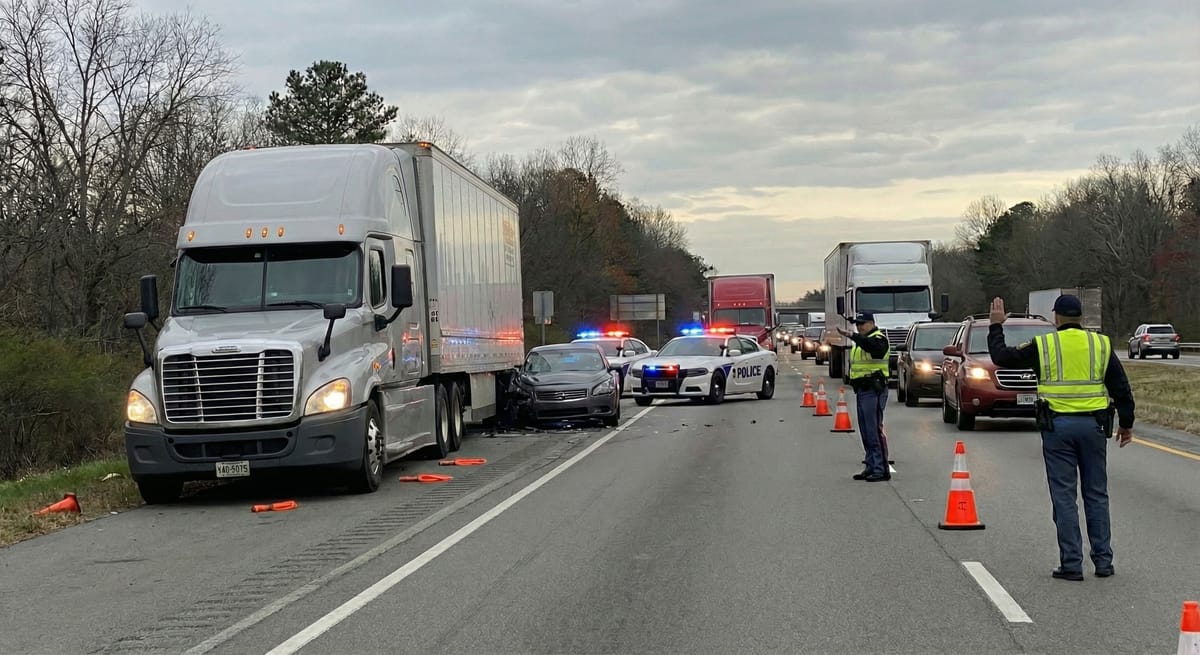
An analysis of 1.3 million DOT carrier crash records (2015-2025), normalized by traffic volume
When we think about dangerous roads, we often think about raw crash counts. But a highway with 10,000 daily trucks and 100 crashes is fundamentally different from a rural route with 500 daily trucks and the same 100 crashes. The second road is far more dangerous per vehicle.
This analysis uses 1.34 million commercial vehicle crash records from DOT carriers, combined with traffic volume data from FHWA, to identify which roads are truly the most dangerous when you account for how much traffic they carry.
The Top 10 Most Dangerous Roads
After normalizing by truck traffic volume, these roads emerged as the most dangerous in America:
| Rank | Road | Danger Score | Total Crashes | Fatalities | Injuries |
|---|---|---|---|---|---|
| 1 | SR-30 (NE) | 12.62 | 262 | 13 | 164 |
| 2 | SR-13 (VA) | 9.16 | 150 | 19 | 99 |
| 3 | I-80 (WY) | 9.12 | 5,475 | 277 | 2,684 |
| 4 | SR-222 (PA) | 7.75 | 1,005 | 38 | 492 |
| 5 | US-127 (OH) | 6.58 | 224 | 16 | 135 |
| 6 | SR-160 (CO) | 6.13 | 307 | 26 | 105 |
| 7 | US-90 (FL) | 5.80 | 347 | 23 | 310 |
| 8 | SR-33 (OK) | 4.42 | 128 | 15 | 63 |
| 9 | SR-94 (ND) | 3.97 | 107 | 1 | 21 |
| 10 | I-25 (WY) | 3.84 | 825 | 13 | 281 |
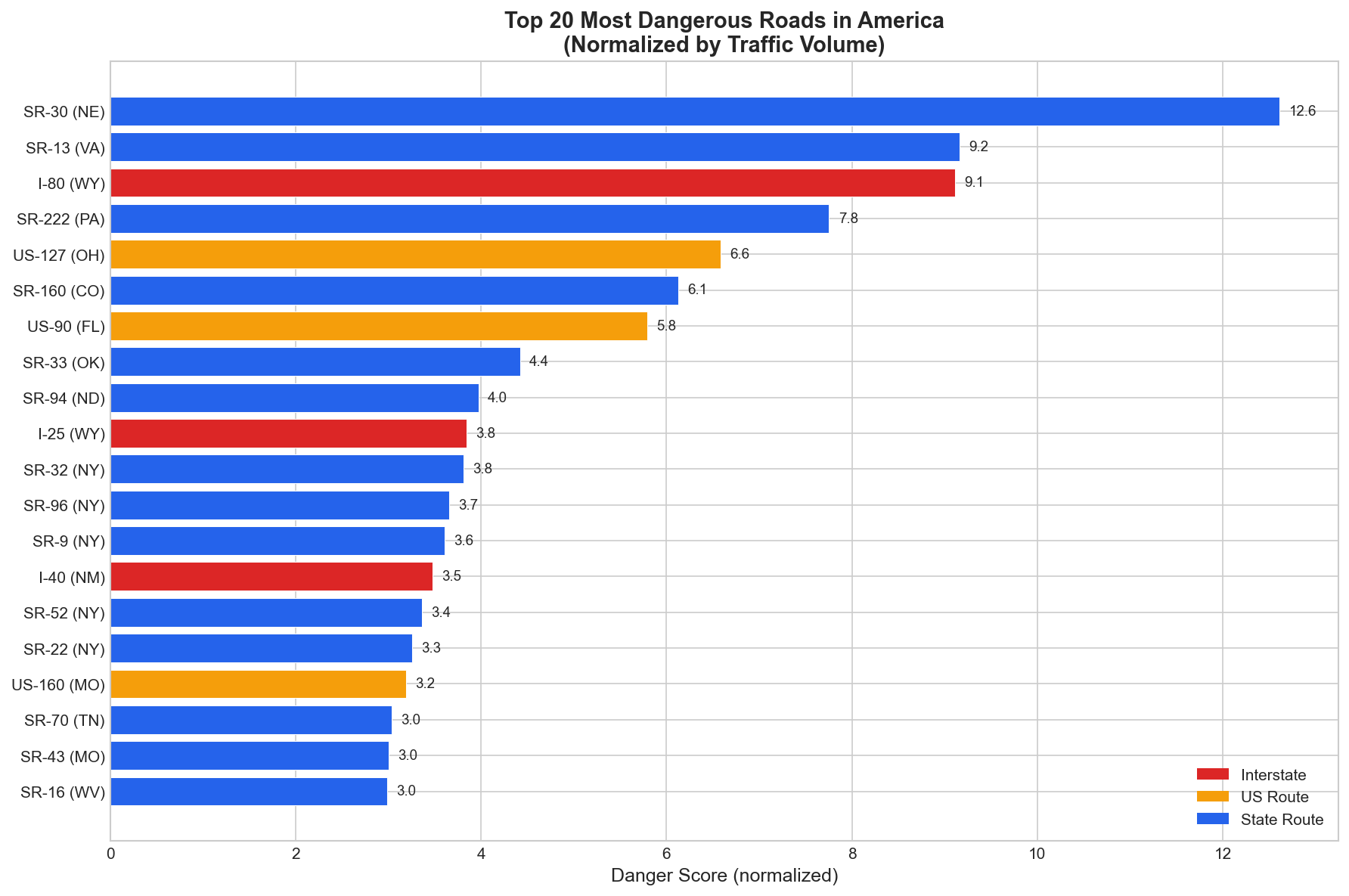
I-80 through Wyoming stands out as particularly notable. It combines high absolute crash counts (5,475 crashes, 277 fatalities) with a high normalized danger score. This isn't just a busy road with proportionally normal crashes—it's genuinely dangerous relative to its traffic volume.
Why These Roads?
Looking at the characteristics of the most dangerous roads reveals some patterns:
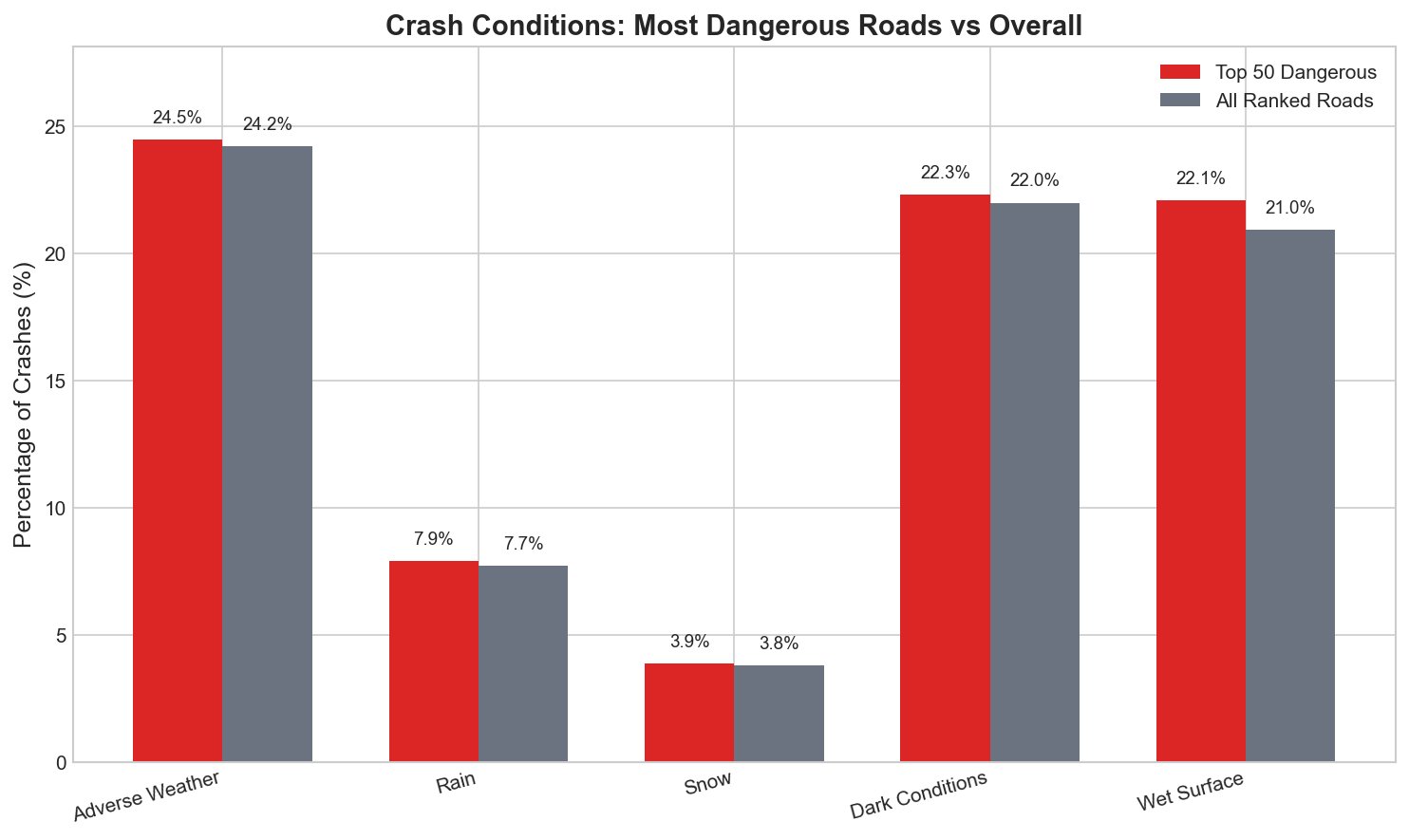
Weather plays a significant role. The top 50 dangerous roads see 24.5% of crashes in adverse weather conditions, compared to 21.8% overall. That's a 12% relative increase—not dramatic, but meaningful.
More telling is the road type distribution:
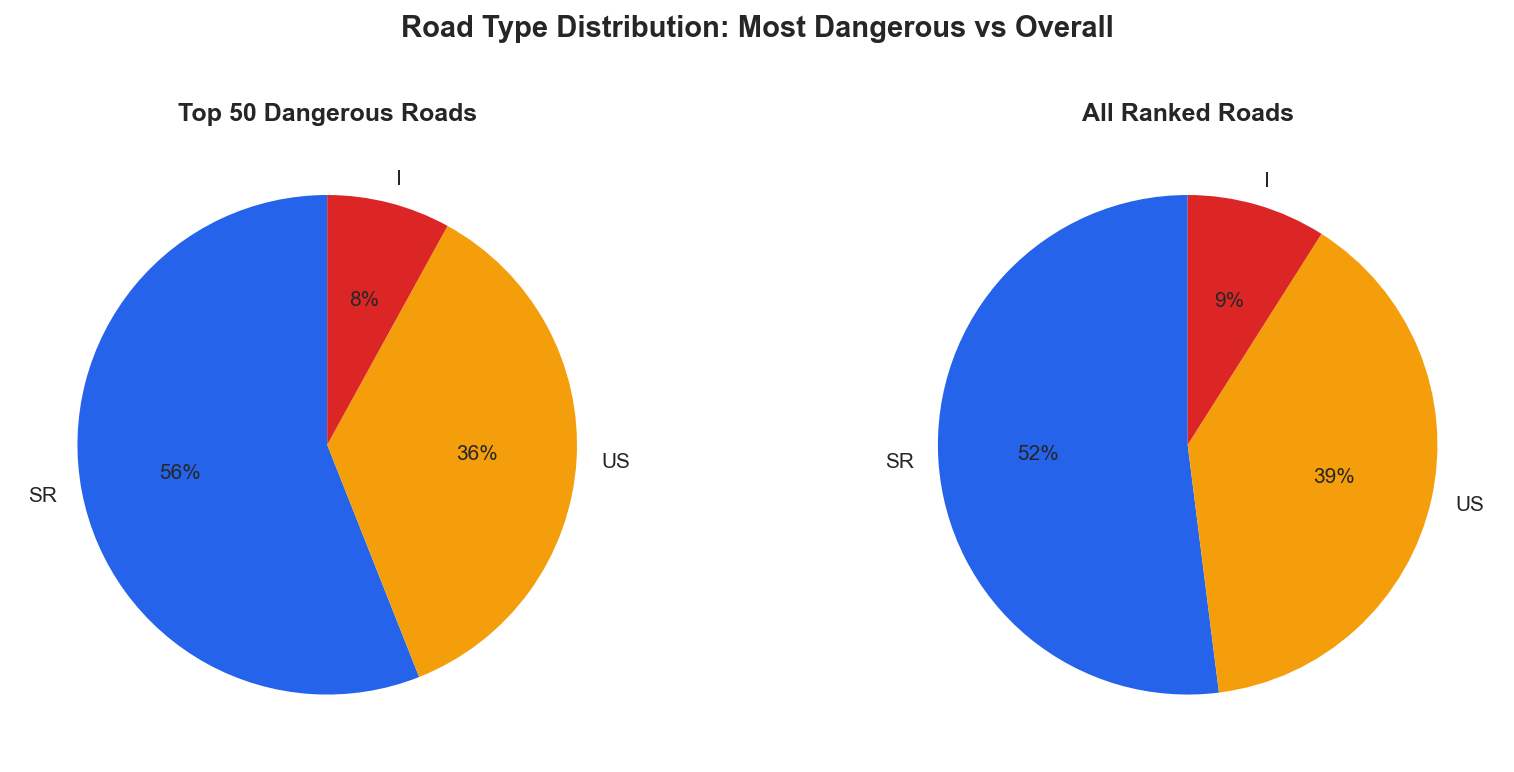
US Routes are overrepresented in the most dangerous roads. While they make up 23% of all ranked roads, they account for 36% of the top 50 dangerous roads. These are often two-lane highways with:
- Higher speed differentials between vehicles
- Less access control (more intersections and driveways)
- Mixed traffic patterns
Interstates, despite carrying heavy truck traffic, are underrepresented in the danger rankings—8% of the top 50 vs 23% overall. Controlled access and modern highway design make a difference.
Fatalities vs Injuries
Not all dangerous roads are dangerous in the same way:
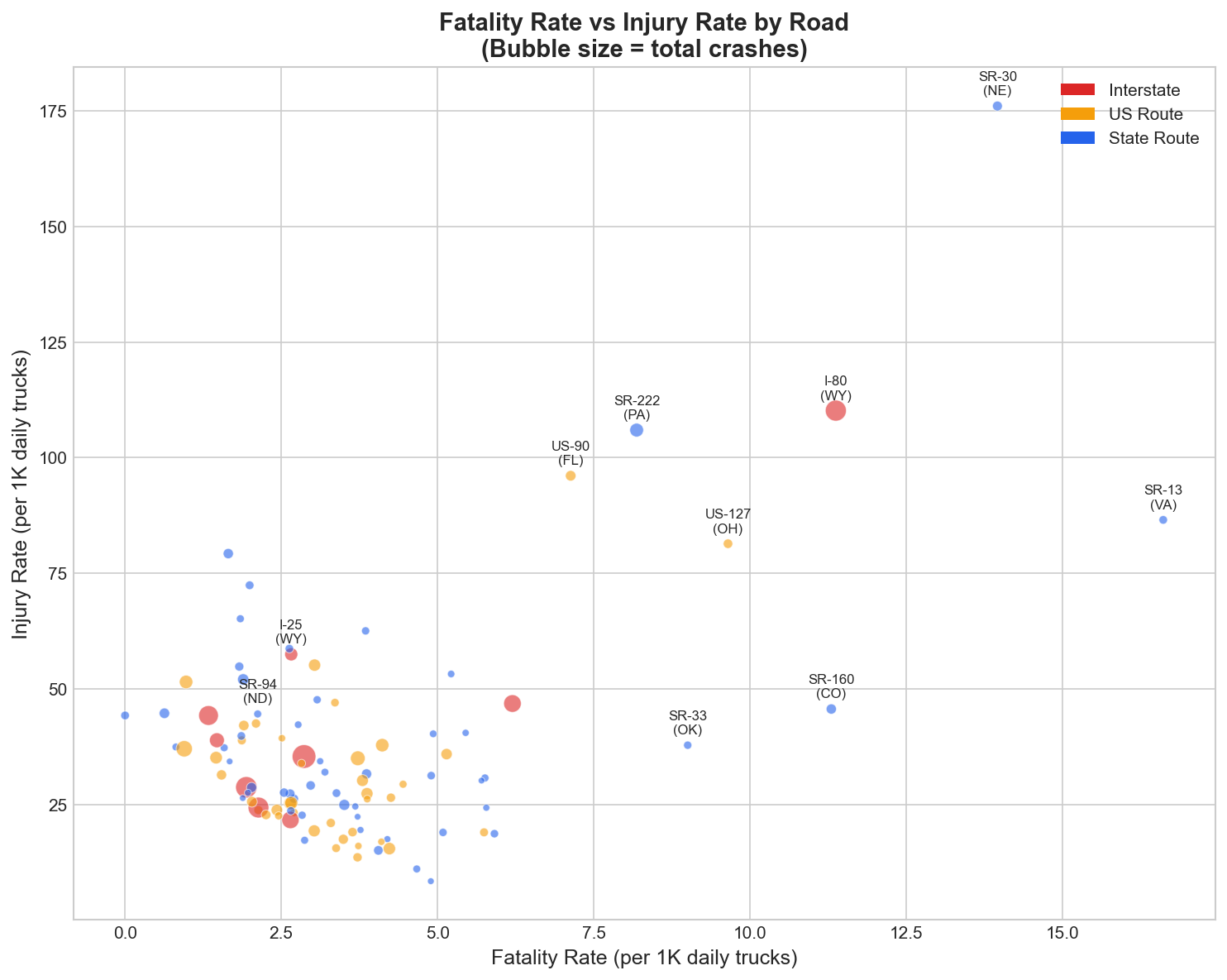
Some roads have high fatality rates but moderate injury rates (often remote roads where crashes are more severe but less frequent). Others have high injury rates but lower fatality rates (often congested corridors with more fender-benders).
I-80 (WY) sits in the upper right—high on both dimensions. The combination of harsh winter weather, long remote stretches, and high-speed traffic creates conditions where crashes are both frequent and severe.
Crash Severity Breakdown
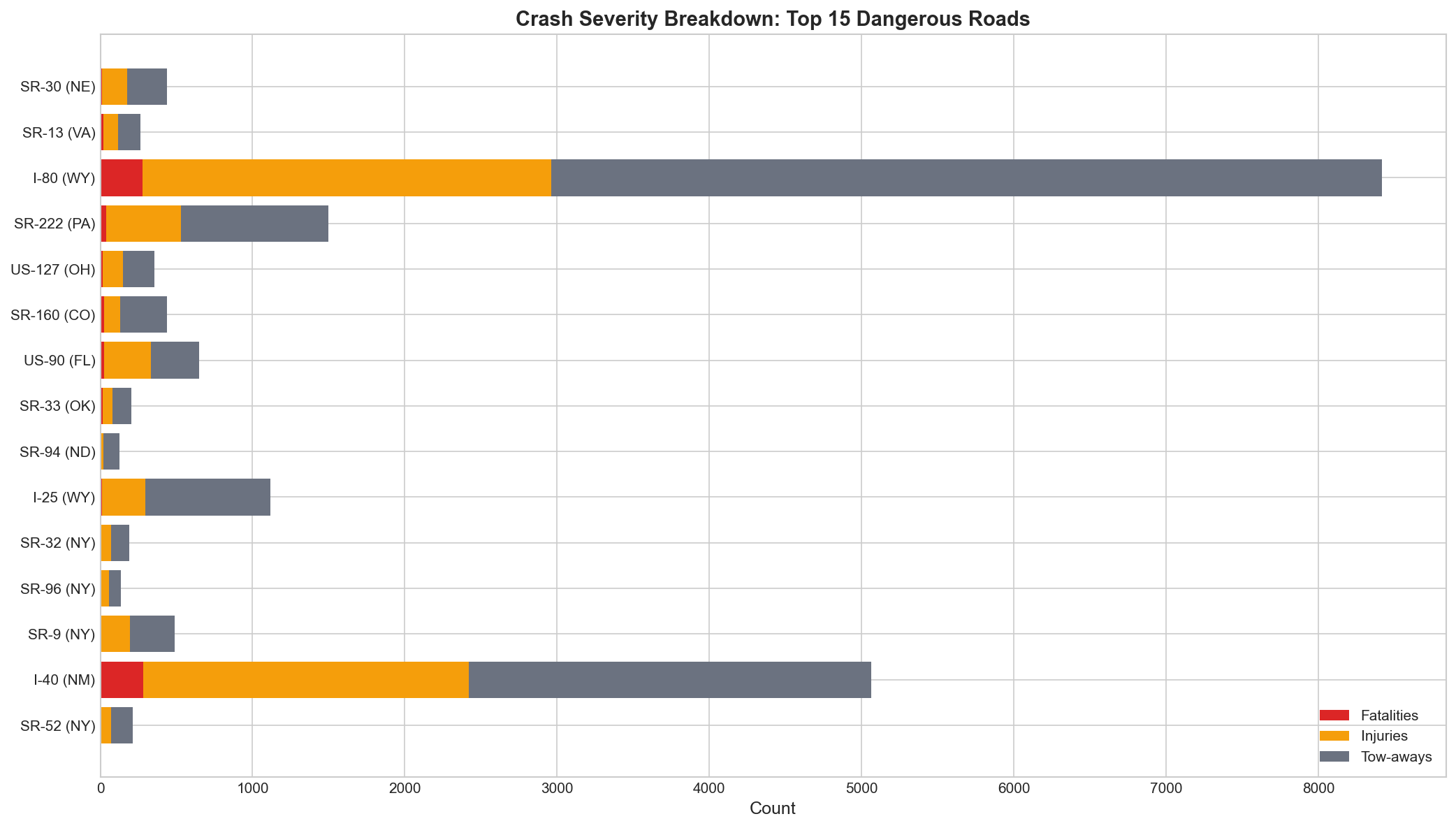
The severity breakdown shows how crash outcomes vary by road. Some roads have a higher proportion of fatal crashes (SR-13 in Virginia), while others see more injuries relative to fatalities.
Geographic Distribution
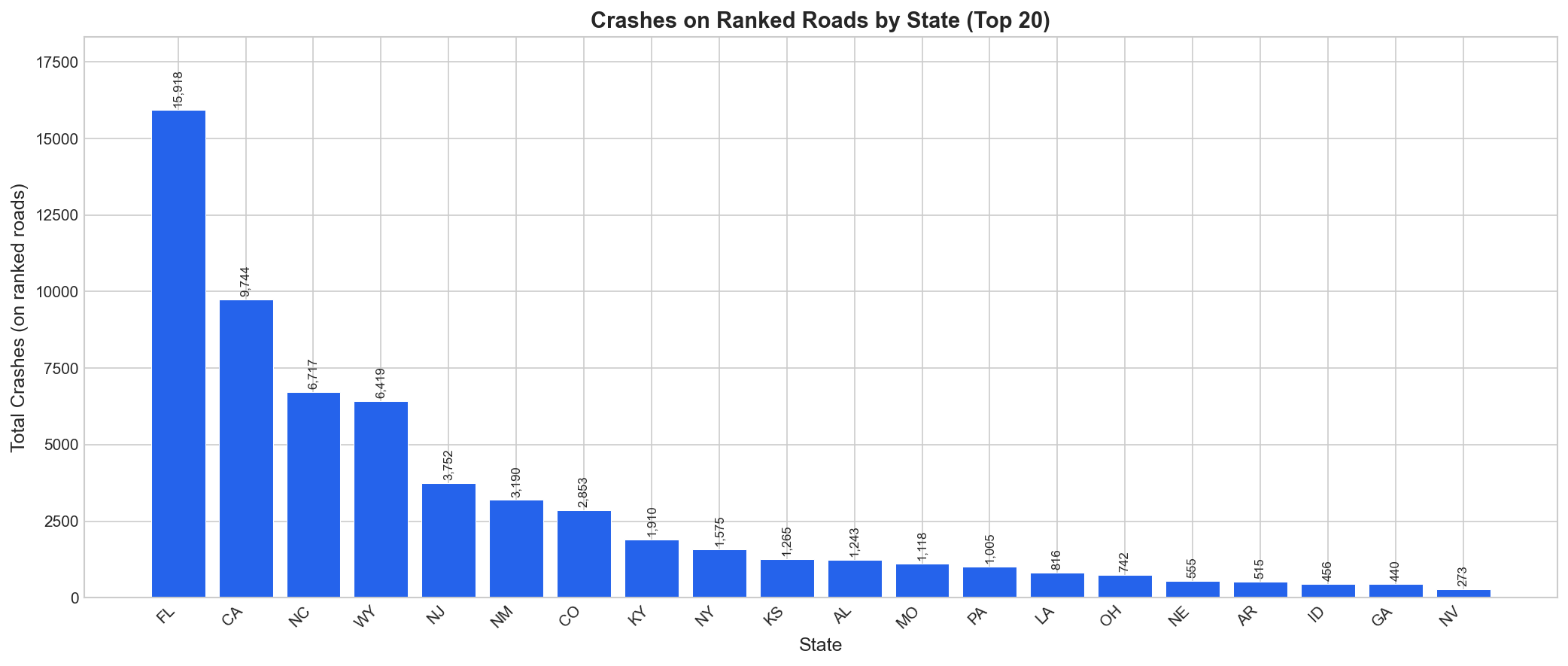
Looking at total crashes on ranked dangerous roads by state, we see concentrations in states with:
- Major interstate corridors
- Significant freight movement
- Challenging weather conditions
What Makes a Road Dangerous?
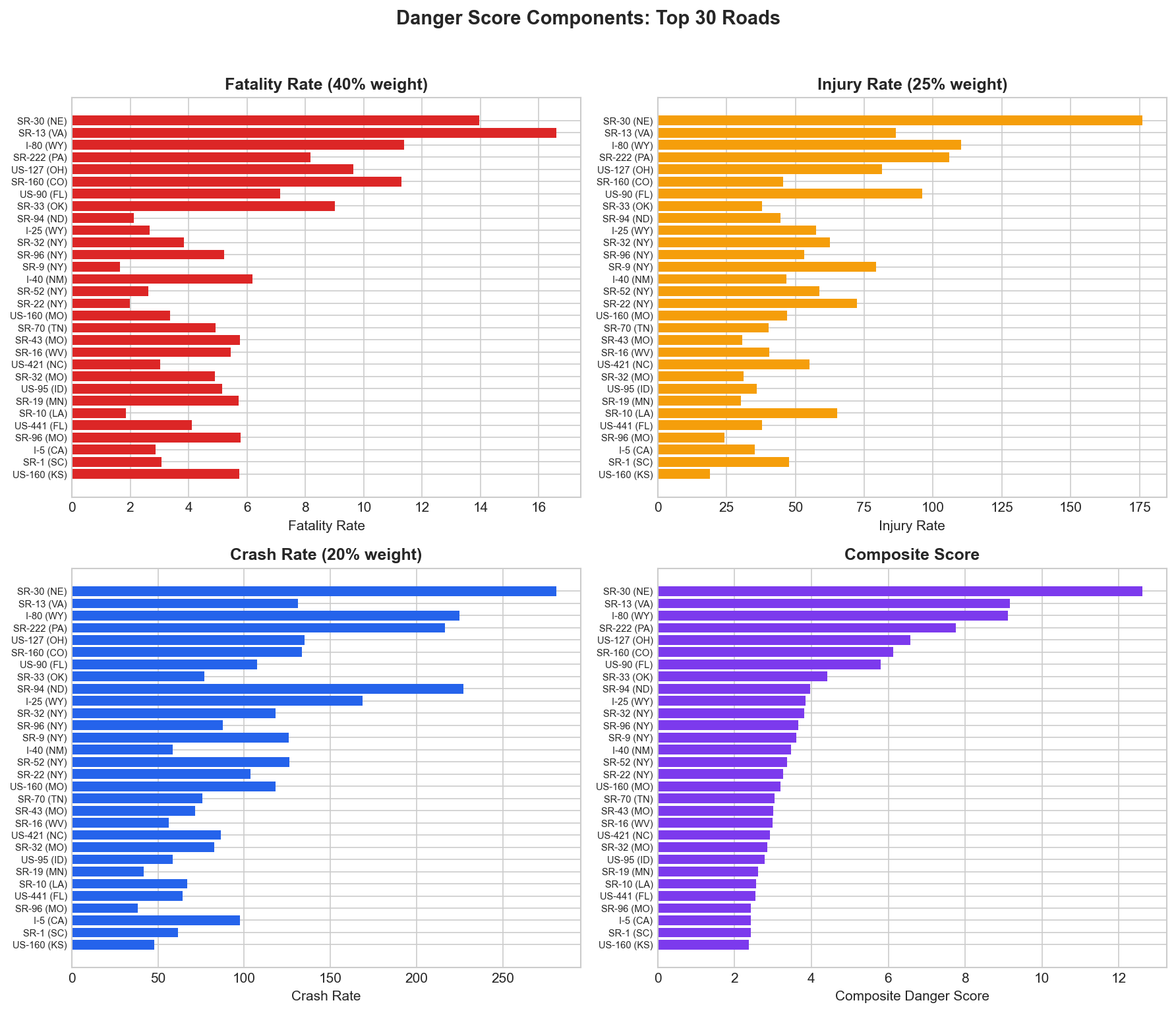
The composite danger score weighs four factors:
- Fatality rate (40%) — Deaths per unit of truck traffic
- Injury rate (25%) — Injuries per unit of truck traffic
- Crash rate (20%) — Total crashes per unit of truck traffic
- Severity rate (15%) — Weighted severity per unit of traffic
This weighting prioritizes roads where crashes have serious outcomes, not just high crash counts.
Methodology
Data sources:
- 1,341,932 commercial vehicle crash records (2015-2025) from DOT carrier reports
- Traffic volume (AADT) data from FHWA Highway Performance Monitoring System
Normalization approach:
- Crash locations were normalized to canonical road IDs using a hybrid regex + LLM approach (83.2% classification rate)
- Crashes were aggregated by state-level road segment (e.g., "I-80 (WY)" is distinct from "I-80 (PA)")
- Rates were computed per 1,000 daily trucks
- Roads with fewer than 50 crashes or less than 100 daily truck AADT were excluded to reduce noise
Limitations:
- Traffic data is from 2018; crash data spans 2015-2025
- Some road segments may have incomplete location data
- Commercial vehicle crashes only—does not include passenger vehicle crashes
Key Takeaways
-
Raw crash counts are misleading. High-traffic interstates have many crashes but may actually be safer per vehicle than low-traffic rural routes.
-
US Routes are disproportionately dangerous. Two-lane highways with mixed traffic and limited access control pose higher risks per vehicle.
-
I-80 through Wyoming deserves its reputation. It's dangerous both in absolute terms and normalized by traffic.
-
Weather matters, but less than you might think. Adverse weather accounts for about 25% of crashes on the most dangerous roads—significant, but not the dominant factor.
-
Road design matters more. The underrepresentation of interstates in the danger rankings suggests that controlled access and modern highway design significantly reduce risk.